
Setting Up Assumptions in a Financial Model
Every financial model is only as good as the assumptions behind it—and that’s where the real struggle begins.
📌 Where do we start?
Data Overload vs. Data Scarcity
We need historical trends, industry benchmarks, and operational data (sales volume, churn, conversion rates, etc.), but either we don’t have enough or have too much noise.
Connecting Operational Data to Financials
Knowing what impacts revenue, costs, and cash flow is one thing; quantifying it is another. Are we accounting for utilization, efficiency, pricing, and working capital correctly?
Making Relationships Quantifiable
Past performance ≠ future certainty. Can we trust the correlations we identify? How do we balance historical insights with market expectations?
📌 What makes assumptions risky?
Scenario Planning is Tough
Revenue growth, EBITDA margins, exit multiples… we need to test different outcomes, but how do we set reasonable ranges without wild guessing?
Debt & Cash Flow Projections
Debt repayments impact interest expenses, which impact net income, which impacts free cash flow. One incorrect assumption can cause a chain reaction.
Investor Return Calculations
Small assumption errors can drastically change IRR or multiple on invested capital, leading to unrealistic expectations.
📌 What can we do about it?
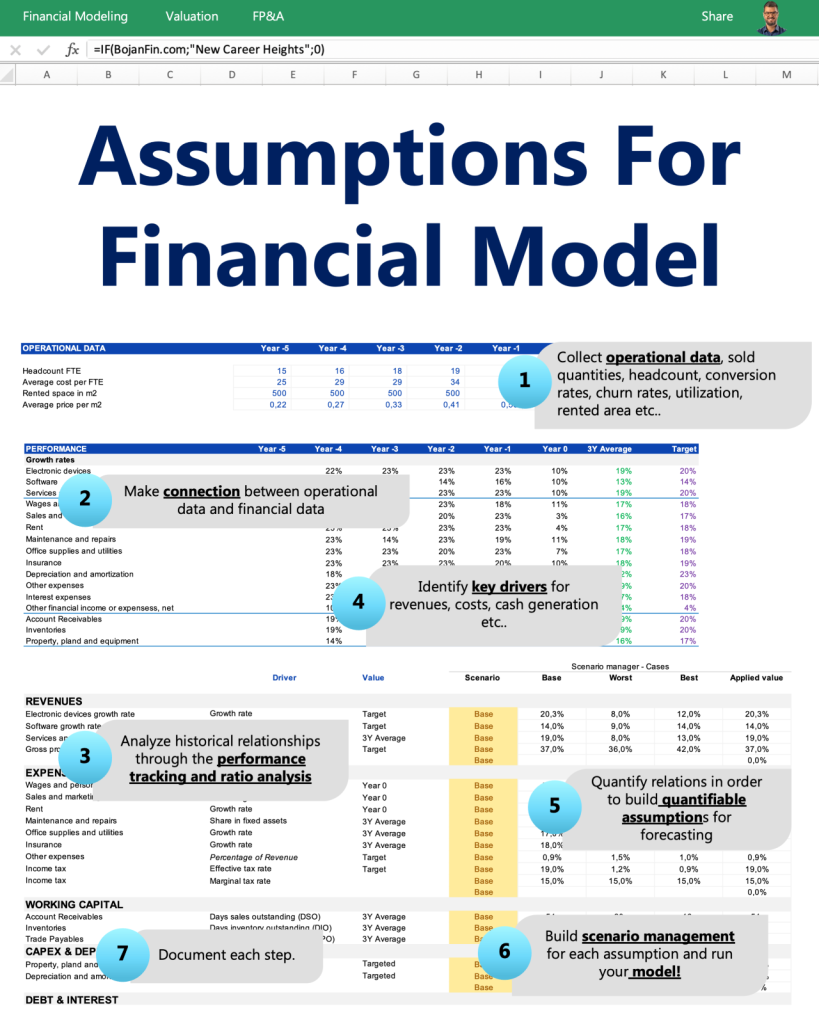
✅ Track historical performance & ratios – Identify key revenue and cost drivers early.
✅ Tie operational data to financial forecasts – Every assumption should have a logical basis.
✅ Run sensitivity analysis – Understand how assumptions interact.
✅ Document everything – If we can’t explain an assumption, we probably shouldn’t use it.
💡 Modeling isn’t about perfect predictions; it’s about building a flexible framework for decision-making.
What’s the toughest assumption you’ve had to deal with in a financial model?
Here is my visual for today. You can download it here.
If you want to master modeling, click here to join 6.500 students in my FINANCIAL MODELING PROGRAM
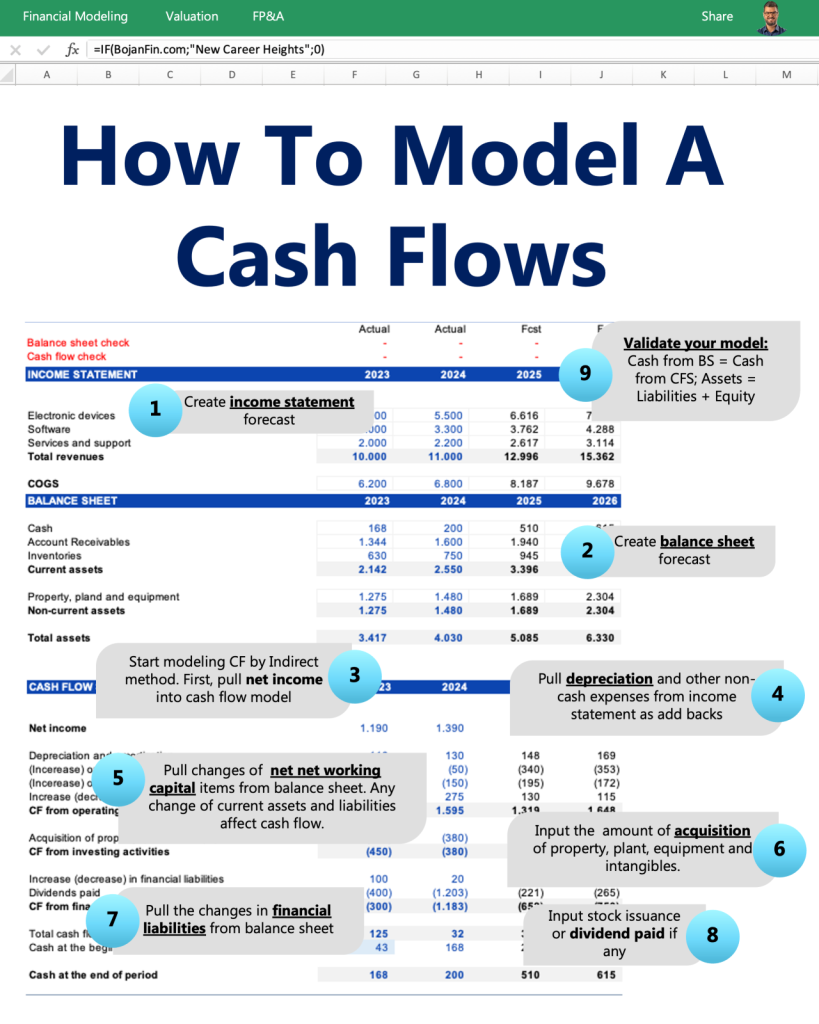
How do you estimate your cash flows?
I am not talking about forecasting short-term cash needs, but rather about a strategic approach to cash flow forecasting.
Try this cash flow model.
If you:
❌ Have a feeling you have lack cash, even though profit is high
❌ Worried about making costly mistakes in your cash planning
❌ Find it difficult to keep up with the fast-changing financial landscape
This is what you can do:
👉 Make smart decisions based on realistic cash flow forecast
👉 Contribute to value creation based on strategically driven models.
👉 Help stakeholders make decisions based on DCF valuations.
👉 Present clear cash KPIs to management that leave no questions.
What is your key challenge when it comes to cash flow forecasting?
Here is my visual for today. You can download it here.